-

Scale up or down seamlessly
-

Increase scalability and flexibility

-
Optimize costs

Discover Our Western NY Managed IT Services
-
Virtual Private Servers (VPS)
Get dedicated resources and control while sharing hardware with other VPS instances
-
Managed Cloud Hosting
Professional management and support for cloud servers ensures the best performance and security

-
Scalability and Resource Management
Use on-demand resource scaling and resource allocation for peak performance and cost control

-
Data Backup and Disaster Recovery
Our robust solutions safeguard your data and help you recover faster from any disaster
-
Load Balancing Services
Distribute traffic across multiple servers to maintain high availability and reliable performance

-
Security and Compliance Solutions
Our comprehensive approach includes custom firewalls, intrusion detection and compliance adherence

Are Your Cloud Hosting Providers Causing Headaches?
- Does it feel like you don’t know what you don’t know when it comes to cloud computing?
- Are you unsure how much time and resources to invest in the cloud?
- Does managing cloud service issues feel like trying to solve a Rubik’s cube?
We get it: Cloud computing can be a complex puzzle. Call on SynchroNet to clear the skies.
Get to Cloud 9
We understand cloud hosting providers seem to be everywhere. How do you know which to choose or even what you need in cloud computing?
But don't worry, we're here to simplify cloud services for your specific business. At SynchroNet, we make sure your technology runs smoothly and securely, so you can focus on your core business with the peace of mind you deserve.
Partner with us for a more secure digital future.
-
Repeat IT issues cut by 60 percent after 3 - 6 months
-
60-day “no questions asked” refund policy
-
80 + businesses trust SynchroNet for IT services

SynchroNet Customers Say

































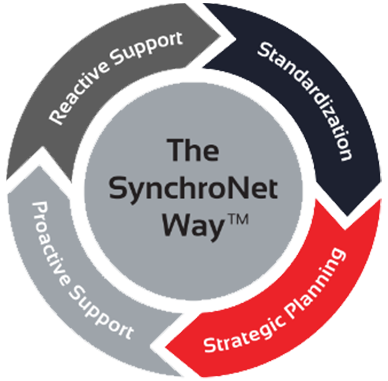
The SynchroNet Way
Want to move your business IT from the wild, wild West to an island of serenity? We get it, and we’ve helped transform everyday work life for hundreds of clients using The SynchroNet Way.
With our approach you get:
-
Standardization and a 100-point Best Practices checklist assigned to a dedicated network administrator.
-
Strategic planning at an executive level with a dedicated vCIO that keeps you on track for the long run.
-
Proactive support that monitors and protects your systems around the clock.
-
Reactive support from our friendly and caring customer support team who are always on the lookout for repeat issues.

Don't Get Caught Up in the Chaos

What's at stake with cloud computing and cloud server hosting services? By not taking advantage of the right cloud services, you could be pouring resources like time and money down the drain.
Don’t risk stagnation, data loss or cloud confusion.
FAQs
Cloud Server Hosting Services allow Western New York businesses to run applications, store data and access computing power over the internet, without relying on local servers or on-site hardware. Cloud computing transforms operations by improving flexibility, supporting remote work, reducing hardware costs and maintaining access to critical systems during disruptions.
Core cloud computing capabilities include:
- Virtualized infrastructure: Applications and workloads run on virtual servers managed by the cloud provider instead of on-premises hardware, improving flexibility and reducing infrastructure limitations.
- On-demand scalability: Computing and storage resources scale based on business demand without requiring additional hardware purchases.
- Remote system access: Employees can securely access applications, files and business systems from virtually any location with an internet connection.
- Lowered hardware dependency: Server maintenance, hardware upgrades and equipment lifecycle management shift from internal teams to the cloud provider.
- Operational continuity: If local infrastructure fails, cloud-hosted systems remain accessible through distributed, geo-redundant environments, keeping the business running.
To understand the different ways cloud can be deployed for your business, visit our Cloud Computing page or read our answer to this related question: What are the different types of cloud computing (Public, Private, Hybrid)?
Cloud Server Hosting Services are delivered in three primary models: public, private and hybrid. Each model offers different trade-offs in cost, control and security. The right choice depends on your business requirements, compliance obligations and how your applications and data need to be managed.
Cloud deployment models include:
- Public cloud: Computing resources are delivered using shared infrastructure managed by a third-party provider such as Microsoft Azure or Amazon Web Services (AWS). Public cloud environments offer scalability, flexibility and cost efficiency for many business applications.
- Private cloud: Dedicated infrastructure is reserved for a single organization, providing greater control, customization and security for sensitive workloads and regulated environments.
- Hybrid cloud: Sensitive systems run in a private environment, while less critical applications use public infrastructure to control costs and security.
- Workload segmentation: Compliance-sensitive applications (HIPAA-regulated data, CUI) typically run in private or isolated environments, while communication and collaboration tools run in a public cloud.
- Interoperability: Hybrid environments use secure integrations that allow applications and data to move between cloud environments while maintaining appropriate security controls.
To explore how cloud adoption supports your business modernization, visit our Cloud Computing page or read our answer to this related question: Why is cloud migration an important step for aging businesses?
Cloud Server Hosting Services replace aging on-premises infrastructure with scalable, cost-efficient cloud environments. For many established Western New York businesses, cloud migration improves operational flexibility, reduces hardware dependency and creates a stronger foundation for future growth.
Benefits of cloud migration include:
- Infrastructure modernization: Legacy servers are replaced with cloud-based systems that support modern applications, cybersecurity requirements and automation tools.
- Cost structure improvement: Capital expenses for hardware are reduced by transitioning to subscription-based cloud operating models that scale with your business needs.
- Improved resilience and business continuity: If local systems fail, cloud environments maintain availability through geo-redundant infrastructure, keeping operations running during outages.
- Security standard alignment: Cloud platforms support modern security controls, including encryption, identity and access management (IAM) and compliance frameworks such as NIST and SOC 2.
To understand cloud deployment options in more detail, visit our Cloud Computing page or read our answer to this related question: What are the different types of cloud computing (Public, Private, Hybrid)?